http://www.frencheuropean.com/Rare%20Prints/Costumes%20of%20South%20America.htm
Indigenous Peoples are a significant and important portion of humanity. Their heritage, their ways of life, their stewardship of this planet, and their cosmological insights are an invaluable treasure house for us all.
The word Indigenous has many meanings. In every region of the world, many different cultural groups live together and interact, but not all of these groups are considered indigenous or inherent to their particular geographic area. In fact, it is only in the face of a collective or shared sense of identity that the term indigenous peoples has been internationally recognized.
Indigenous Peoples live in every region of the world. They live in climates ranging from Arctic cold to Amazon heat, and often claim a deep connection to their lands and natural environments. For many indigenous peoples, the natural world is a valued source of food, health, spirituality and identity. Land is both a critical resource that sustains life and a major cause of struggle and even death.
Each indigenous culture is distinct and unique. While many peoples may express similar worldviews and a common indigenous identity, their cultures are nonetheless based on different histories, environments, and creative spirits.
Source: http://www.indigenouspeople.net/sidemenu.html
Indigenous population in Peru make up around 30% Native Peruvian traditions and customs have shaped the way Peruvians live and see themselves today. Cultural citizenship—or what Renato Rosaldo has called, "the right to be different and to belong, in a democratic, participatory sense" (1996:243)—is not yet very well developed in Peru. This is perhaps no more apparent than in the country's Amazonian regions where indigenous societies continue to struggle against state-sponsored economic abuses, cultural discrimination, and pervasive violence.
The Amerindians make up 0.4% of Brazil's population, or about 700,000 people. Indigenous peoples are found in the entire territory of Brazil, although the majority of them live in Indian reservations in the North and Centre-Western part of the country. On 18 January 2007,FUNAI reported that it had confirmed the presence of 67 different uncontacted tribes in Brazil, up from 40 in 2005. With this addition Brazil has now overtaken the island of New Guinea as the country having the largest number of uncontacted tribes.
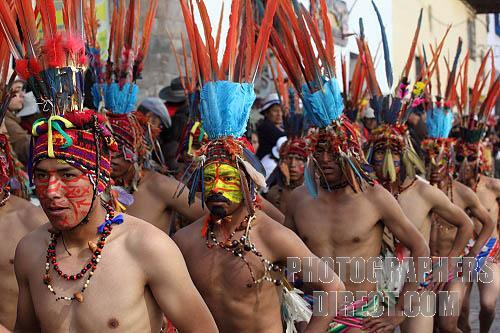
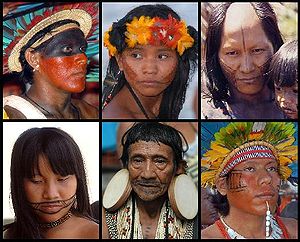
Indigenous peoples of South America traditionally use annatto,huito, or wet charcoal to decorate their faces and bodies. Huito is semi-permanent, and it generally takes weeks for this black dye to fade.
These are some examples of body painting in South American countries, mainly Brazil and Peru.